
Understand online blackjack payouts and house edge. Compare 3:2 vs 6:5 tables, dealer soft 17 rules, insurance odds, and side bets.
Last updated:Blackjack’s house rules decide what each hand pays and how much the casino expects to keep. The deck of cards is the same everywhere, yet one rule, such as 6:5 instead of 3:2 on a natural, can raise your expected cost several times over. This guide covers what every result pays, how each table rule changes the house edge, the math on insurance and side bets, and a checklist for the rules panel.
Key Takeaways: Blackjack Payouts and House Edge in Canada
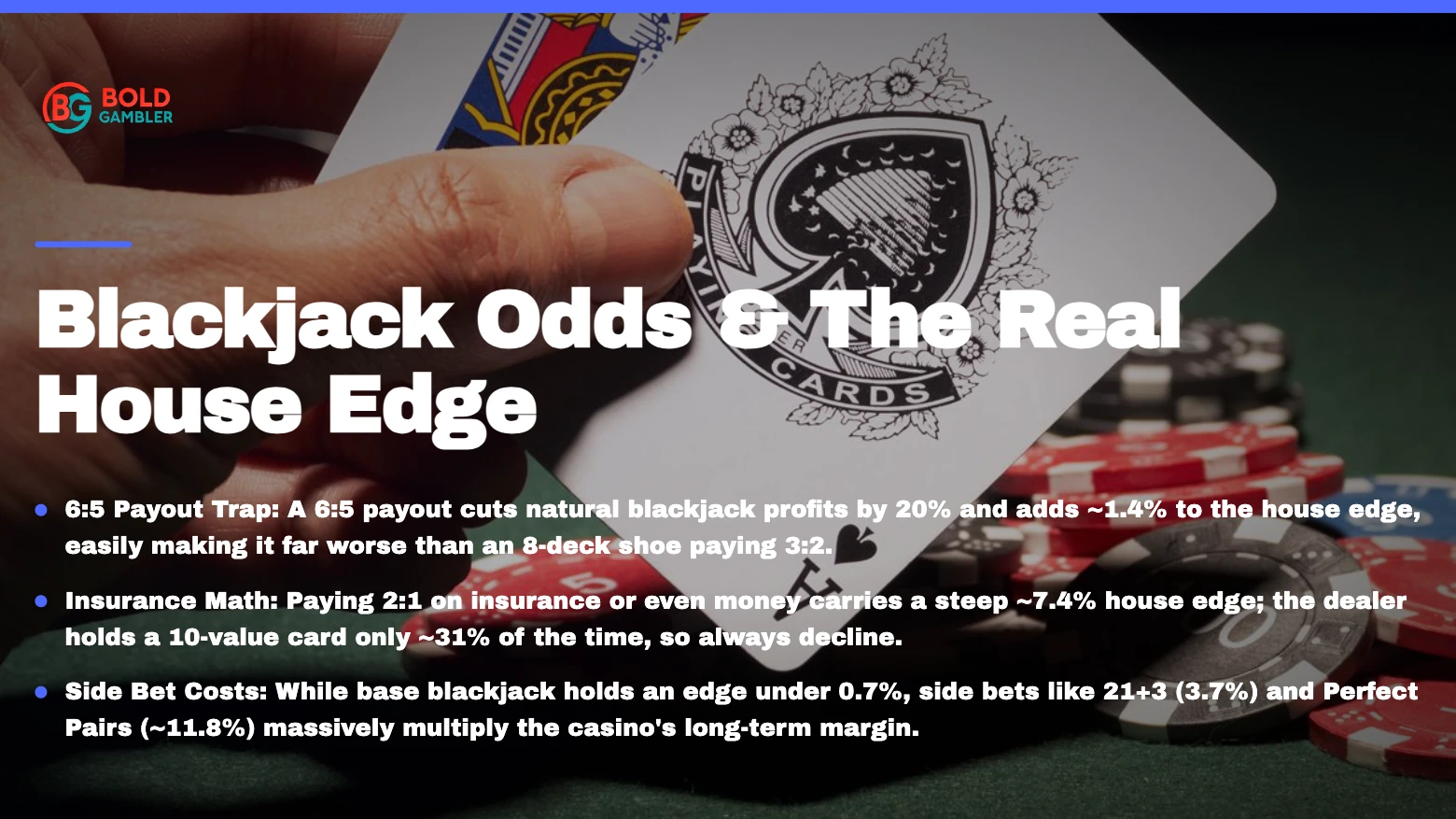
- Natural Payout Impact: Choosing a table that pays the standard 3:2 on a natural blackjack is critical; playing at a 6:5 table reduces profits on naturals by 20% and adds roughly 1.4% directly to the house edge.
- Baseline Mathematical Cost: Under optimal basic strategy at multi-deck tables paying 3:2, the house edge typically sits between 0.4% and 0.7% (99.3% to 99.6% RTP), depending on specific dealer and doubling rules.
- Rules Influencing the Edge: Player-favourable conditions like Double After Split (DAS) and late surrender lower the casino’s advantage, whereas dealer hits on soft 17 (H17) and European No Hole Card (ENHC) increase expected losses.
- High Cost of Extras: Insurance and even-money wagers carry an unfavourable ~7.4% house edge in multi-deck shoes, while popular side bets like Perfect Pairs (~11.8%) and 21+3 (3.70%) cost significantly more over time than the base game.
What Each Blackjack Result Pays
When the round ends, the table compares your hand with the dealer’s and settles the bet. Ordinary wins pay even money (1:1), a natural traditionally pays 3:2, and a push returns your bet. The table shows each result on a C$100 bet.
| Result | When It Happens | Payout | Net Result on a C$100 Bet |
| Regular win | Your total beats the dealer’s without busting, or the dealer busts | 1:1 | +C$100 |
| Natural blackjack (3:2 table) | Ace plus a 10-value card on the deal | 3:2 | +C$150 |
| Natural blackjack (6:5 table) | Ace plus a 10-value card on the deal | 6:5 | +C$120 |
| Insurance win (C$50 side bet) | Dealer shows an Ace and has a 10-value hole card | 2:1 | +C$100 on the insurance bet |
| Push | You and the dealer finish on the same total | Bet returned | C$0 |
| Surrender | You fold your first two cards, where offered | Half the bet returned | -C$50 |
| Loss or bust | You bust, or the dealer finishes closer to 21 | None | -C$100 |
In practice, a C$100 natural at a 3:2 table wins C$150, so C$250 returns to your balance. At a 6:5 table the same hand wins C$120 and returns C$220. If you and the dealer both finish on 19, the hand pushes and the C$100 comes back untouched. How to play online blackjack explains what counts as a natural.
Why 3:2 Beats 6:5 on a Natural
Of all the rules at a blackjack table, the payout on a natural matters most. Standard games pay 3:2, while some modified tables pay 6:5 or even 1:1.
Paying 6:5 trims your profit on every natural by 20%. A natural arrives about 4.75% of the time, so the effect is roughly 1.4% more house edge, and a 1:1 payout adds about 2.3%.
| Bet | Natural Pays at 3:2 | Natural Pays at 6:5 | Lost per Natural |
| C$20 | C$30 | C$24 | C$6 |
| C$100 | C$150 | C$120 | C$30 |
| C$500 | C$750 | C$600 | C$150 |
Better play cannot make up for a worse payout. Single-deck games are often paired with 6:5, so a table that looks generous because it uses one deck can cost more than an eight-deck table paying 3:2. Some Canadian online lobbies list 3:2 and 6:5 versions of the same game side by side, so pick the 3:2 table, and if the payout is not displayed, look it up in the rules panel before you bet.
House Edge and RTP in Blackjack
The house edge is the portion of each bet the casino expects to keep in the long run, and Return to Player (RTP) is 100% minus that figure. Most of the blackjack edge comes from the order of play: you act first and can bust before the dealer does anything, so a double bust is still your loss.
With perfect basic strategy at a 3:2 table with six or eight decks, the edge usually lands between about 0.4% and 0.7%, an RTP of roughly 99.3% to 99.6%. Weak rules lift it quickly: 6:5 on a natural, eight decks and a dealer who hits soft 17 together take the cost to about 2.06%.
| Table Setup | House Edge | Expected Cost per C$1,000 Wagered |
| One deck, 3:2, dealer hits soft 17, double after split | 0.16% | C$1.60 |
| Eight decks, 3:2, dealer stands on soft 17, double after split | 0.44% | C$4.40 |
| Eight decks, 3:2, dealer hits soft 17, double after split | 0.66% | C$6.60 |
| Eight decks, 6:5, dealer hits soft 17, double after split | 2.06% | C$20.60 |
The figures assume perfect basic strategy, no surrender and re-splitting to four hands. They describe millions of hands rather than one session, in which luck can push your balance either way.
The Table Rules That Move the House Edge
Casinos set their margin by adjusting individual rules. Each rule either helps or hurts you, and the effects stack.
| Rule | What It Means | Effect on the House Edge |
| Number of decks | Fewer decks favour you, since every dealt card shifts the make-up of the remaining cards by more | 0.16% with one deck and 0.66% with eight, under the same rules |
| Dealer hits soft 17 (H17) | The dealer draws on an Ace and a 6 instead of standing (S17) | Adds about 0.22% |
| No hole card (ENHC) | The dealer takes the second card after players act, so doubles and splits are exposed to a dealer natural | Adds about 0.11% |
| Double after split (DAS) | You may double down on a hand created by a split | Lowers it by about 0.14% |
| Late surrender | You may fold for half your bet after the dealer checks for a natural | Lowers it by about 0.07% |
| Natural pays 6:5 | A natural pays 6:5 instead of 3:2 | Adds about 1.4% |
Holding the other rules constant, the edge rises from 0.16% with one deck to 0.46% with two, 0.60% with four, 0.64% with six and 0.66% with eight. The soft 17 rule matters because letting the dealer hit gives a weak hand another chance to improve: compared with a dealer who stands on every 17, it costs about 0.22%.
With European No Hole Card (ENHC), the dealer takes the second card only after every player has finished. If you double or split against a dealer 10 or Ace and the dealer then makes a natural, the dealer collects every extra bet along with the original. Double after split and late surrender help in the opposite direction. The player actions guide covers those buttons, and blackjack rule variations and regional games shows how variants mix these rules.
The Math Behind Insurance and Even Money
Because insurance pays 2:1, it breaks even only if the dealer has a natural at least one time in three. With an Ace showing, the chance of a 10-value hole card is lower than that. This table counts the 10-value cards left in the shoe after the dealer’s Ace, before your own cards are considered.
| Decks | Chance of a 10-Value Hole Card | House Edge on Insurance |
| 1 | 16 of 51 cards (31.37%) | 5.88% |
| 2 | 32 of 103 cards (31.07%) | 6.80% |
| 6 | 96 of 311 cards (30.87%) | 7.40% |
| 8 | 128 of 415 cards (30.84%) | 7.47% |
Put simply, each C$100 of insurance in a six-deck game costs about C$7.40 in the long run. Even money, the offer to pay a natural 1:1 immediately when the dealer shows an Ace, is the same bet in disguise and carries the same cost. Basic strategy declines both every time.
Side Bets: Perfect Pairs, Any Pair, 21+3 and Lucky Lucky
Side bets are optional wagers placed beside the main hand. They settle independently, pay big multipliers for specific card combinations and cost far more than the base game.
| Side Bet | What Wins | Typical Payouts | House Edge (8 Decks) |
| Perfect Pairs | Your first two cards form a pair | Mixed pair 5:1, coloured pair 10:1, suited pair 25:1 | About 11.8% |
| Any Pair (as in Infinite Blackjack) | Your first two cards form a pair | Mixed pair 6:1, coloured pair 12:1, suited pair 25:1 | 4.10% (RTP 95.90%) |
| 21+3 | Your two cards plus the dealer’s upcard make a poker hand | Flush 5:1, straight 10:1, three of a kind 30:1, straight flush 40:1, suited three of a kind 100:1 | 3.70% (RTP 96.30%) |
| Lucky Lucky | Your two cards plus the dealer’s upcard total 19, 20 or 21, with bonuses for 6-7-8 and 7-7-7 | Varies by paytable; some versions pay up to 200:1 for a suited 7-7-7 | Varies by paytable |
Perfect Pairs and Any Pair both win when your first two cards share a rank (about 7.47% of the time in an eight-deck shoe), so the cost gap comes purely from the paytable. The common 5:1, 10:1 and 25:1 paytable costs about 11.8%, while the richer 6:1, 12:1 and 25:1 paytable behind Any Pair costs 4.10%. A mixed pair is two cards of the same rank in different colours, a coloured pair shares rank and colour, and a suited pair matches rank and suit.
Even the cheapest side bet in the table costs several times what the main game does, so treat side bets as optional entertainment and read the paytable before adding one. Live games with built-in side bets and multipliers, such as Infinite and Lightning Blackjack, are covered in live dealer vs RNG online blackjack formats.
Five Things to Check in the Rules Panel Before You Bet
Open the rules panel before you place a chip. It is often behind an “i” or question-mark icon, and half a minute there tells you whether the table is worth playing. Check five things:
- A natural pays 3:2, not 6:5 or 1:1.
- The dealer stands on every 17 (S17) instead of hitting soft 17 (H17).
- The dealer peeks for blackjack instead of playing European No Hole Card (ENHC) rules.
- Double after split (DAS) is allowed, preferably on any two cards.
- Late surrender is available, so you can fold a hard 16 against a 10.
Few tables tick every box, so go for the one that ticks the most. Once you are seated, the strategy charts give you the right play for each hand.
What to Read Next: Strategy, Variants and Live Formats
Put these numbers to work with the blackjack strategy and myths guide, then see how other games rewrite the rules in blackjack rule variations and regional games and live dealer vs RNG blackjack formats. The blackjack hub lists every guide. Blackjack is paid entertainment with an expected mathematical cost, so keep to a budget and play responsibly with our responsible gambling page.
❓ Blackjack Payouts, Table Rules and House Edge in Canada: Frequently Asked Questions
Does blackjack pay 3:2 or 6:5?
What is a good house edge for blackjack?
Should I ever take insurance?
Are blackjack side bets worth it?
Do fewer decks lower the house edge?
Author:

Lucas Portela
Owner, BoldGambler • Avanhandava/SP
Oddsmaker, affiliate and content creator in the iGaming industry.