


Learn how to read the craps puck. Master the Comeout and Intermediate roll phases, point rules, and when bets are active or off.
Last updated:Craps confuses people because it moves in cycles rather than single, standalone rounds. Unlike roulette, which resets completely after every spin, craps runs through connected rolls where the rules of the board shift on the fly.
To track the action without getting lost, you only need to watch one marker: the puck. This is the mechanic that everything else in our craps section builds on, so it’s worth locking down before moving to specific bets like the Pass Line.
Key Takeaways: Reading the Craps Puck
- The Visual Indicator: A black puck showing OFF signals a Comeout Roll, while a white puck showing ON marks the established Point number.
- Comeout Phase Outcomes: When the puck is OFF, rolling a 7 or 11 wins Pass Line bets instantly, a 2, 3, or 12 loses immediately, and any box number locks in a Point.
- Intermediate Phase Objective: Once the puck is ON, the shooter must re-roll the established Point to win before landing an ending 7 (Seven Out).
- Working vs. OFF Bets: Secondary wagers like Place Bets and Hardways turn OFF by default during the Comeout toss to prevent early losses, turning active once a Point is set.
The Visual Indicator: Reading the Craps Puck
The puck is a thick, double-sided disk placed directly on the felt. In online games, the software moves and flips it automatically.
- Puck OFF (Black side up): A brand-new round is beginning. No target number exists yet, putting the table in the Comeout Roll phase.
- Puck ON (White side up): A Point is officially locked in. The dealer places the puck inside that specific number’s box (4, 5, 6, 8, 9, or 10).
Stage 1: The Comeout Roll Phase (Puck OFF)
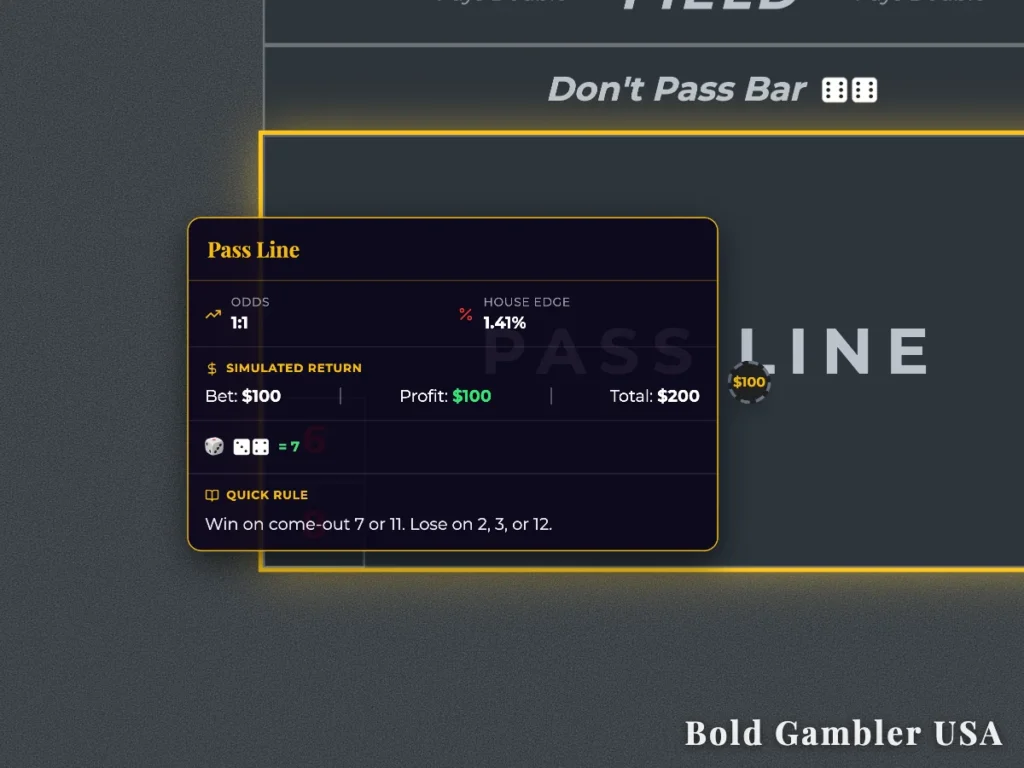
Every cycle starts with the Comeout Roll. If you wager on the Pass Line, your opening roll produces one of three outcomes:
- Natural (7 or 11): Pass Line wins immediately at 1:1. The round ends, and a fresh Comeout begins.
- Craps (2, 3, or 12): Pass Line loses instantly. The round resets into a new Comeout Roll.
- Point Established (4, 5, 6, 8, 9, or 10): That number becomes the target Point for the rest of the sequence. The puck flips to ON and moves to that number box.
Tip: The Comeout phase is the cleanest window to adjust settings, buy chips, or place base wagers without slowing down the action.
Stage 2: The Intermediate Roll Phase (Puck ON)
Once the white ON side is up, the objective flips: the shooter must roll the established Point number again before rolling a 7.
The dice keep rolling until one of two decisive totals lands:
- Hitting the Point: The shooter rolls the Point number. Pass Line wagers cash out, the round ends in a win, and the puck flips back to OFF.
- Seven Out (Rolling a 7): A 7 rolls before the Point. Pass Line wagers lose, active multi-roll bets are swept from the board, and the puck resets to OFF.
Working vs. OFF Status for Bets
Not all bets remain active across both stages:
- Default Behavior: To protect your chips from a quick 7 on the opening toss, bets like Place Bets and Hardways switch to OFF by default during the Comeout Roll.
- Automatic Activation: Once a Point is set and the puck flips to ON, those bets automatically become Working (live).
- Manual Control: Online interfaces allow you to toggle any bet between Working and OFF at any time if you prefer action on every roll.
Author:

Lucas Portela
Owner, BoldGambler • Avanhandava/SP
Oddsmaker, affiliate and content creator in the iGaming industry.